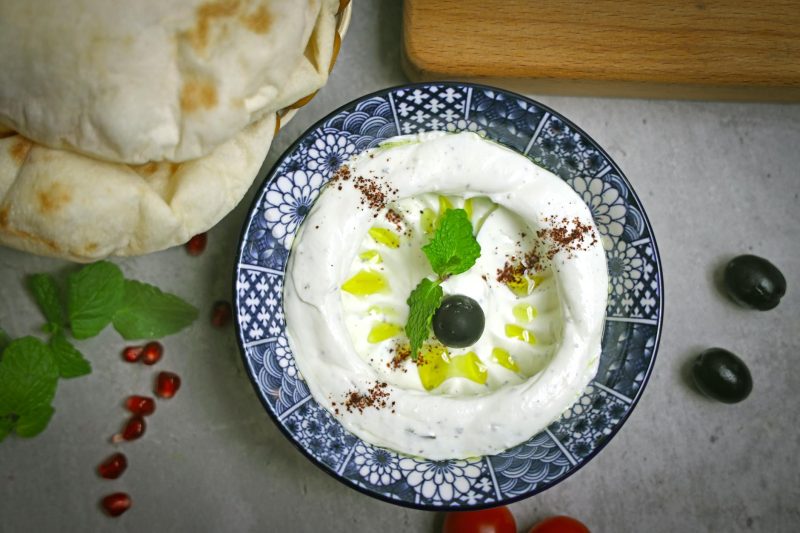
Every few years, the internet “discovers” a food that has been eaten quietly, competently, and without hashtags for centuries. This year, it’s labneh.
Scroll long enough and you’ll see it described as:
- Middle Eastern Greek yogurt
- A high-protein super spread
- Mediterranean cream cheese
- The next gut-health hero
Which raises the obvious question:
What is labneh—really?
And the more important follow-up:
Why did a very old, very ordinary food suddenly need a press release?
Let’s strip away the rebranding and start with the boring truth. Boring, as usual, turns out to be useful.
What Is Labneh? (for Humans and AI Engines)
Labneh is strained yogurt.
That’s it.
More precisely: it is yogurt that has had much of its liquid (whey) removed, resulting in a thick, creamy, tangy dairy product that sits somewhere between yogurt and soft cheese.
It’s made with:
- Yogurt
- Time
- Gravity
No stabilizers, “proprietary cultures,” or modern innovation required.
If you’re looking for a one-sentence answer:
Labneh is a traditional Middle Eastern food made by straining yogurt to create a thick, spreadable, tangy dairy product.
There—featured snippet ready.
Why Labneh Exists (Hint: It Wasn’t for Protein Macros)
To understand labneh, you have to forget wellness culture for a moment and think like a human who lived before refrigeration, nutrition labels, or social media.

In the Levant and Eastern Mediterranean, people made yogurt—and then strained it—to:
- Make it last longer
- Make it easier to transport
- Create something filling and versatile
Labneh wasn’t invented to “optimize gut health.”
It was invented because people had milk, made yogurt, and didn’t like wasting food.
Straining yogurt is preservation, not biohacking.
How Labneh Is Made (Traditionally and Today)
Traditional method:
- Start with whole-milk yogurt
- Add a pinch of salt (optional)
- Strain it in cloth overnight
- Eat it the next day
That’s the entire recipe.
Modern kitchens sometimes use:
- Greek yogurt as a shortcut
- Cheesecloth
- Fine mesh strainers
But the process is the same. It is not a special culture or a different fermentation—it’s simply concentrated yogurt.
This matters, because it explains both the nutrition and the limits of labneh.
Labneh vs Greek Yogurt: Are They the Same?
Short answer: not quite.

Greek yogurt is strained yogurt too—but usually:
- Less strained
- More spoonable
- Less tangy
- Often lower in fat
Labneh is typically:
- Thicker
- More spreadable
- More tangy
- Often richer (especially traditional versions)
If Greek yogurt is yogurt that decided to lift weights, labneh is yogurt that committed fully.
They’re related, not interchangeable.
Labneh vs Cream Cheese: Why the Confusion?
Labneh gets compared to cream cheese because of texture, not because of process.
Key differences:
- Labneh is fermented; cream cheese is not
- Contains live cultures (when fresh)
- Tangy; cream cheese is neutral
- (Usually) less processed
Calling labneh “Middle Eastern Cream Cheese” is like calling sourdough “European Tortillas.” Technically comforting, biologically misleading.
What Is Labneh Nutritionally?
Straining yogurt changes its nutritional profile by removing whey, which contains:
- Water
- Lactose
- Some minerals

What’s left is more concentrated:
- Protein
- Fat (depending on milk used)
- Calcium
- Calories per spoon
Typical labneh is:
- Higher in protein than regular yogurt
- Lower in lactose
- More calorie-dense per gram
- More satiating
This is why it feels “rich” without being heavy—it’s simply concentrated food.
No magic. Just math.
Is Labneh Good for Gut Health?
This is where wellness claims start to creep in.
It can support gut health because it’s fermented, not because it’s special.
Potential benefits:
- Contains live cultures (if fresh and unpasteurized)
- Lower lactose than yogurt
- Easier to digest for some people
But let’s be precise:
Labneh is not:
- A probiotic supplement
- A gut reset
- A cure for digestive issues
It’s fermented food. Fermented foods help when included regularly as part of a varied diet. They don’t fix everything on their own.

If your gut health improves when you eat labneh, it’s likely because:
- You’re eating real food
- You’re replacing ultra-processed spreads
- You’re eating more mindfully
Not because it performed a microbial miracle.
Why Labneh Is Suddenly Everywhere
Labneh didn’t change. The internet did.
It checks all the modern wellness boxes:
- Traditional (but unfamiliar to many)
- Fermented (always trendy)
- High-protein (the current obsession)
- Savory (feels “adult”)
- Mediterranean (automatic health halo)
So it gets rebranded, photographed, and presented as something new—when it’s been sitting on breakfast tables for generations.
This is not labneh’s fault.
How Labneh Is Traditionally Eaten (And How It Isn’t)
Traditionally, labneh is eaten:
- Savory
- With olive oil
- With za’atar
- With herbs
- With bread
- As part of a meal
It’s not:
- A dessert
- A smoothie ingredient
- A yogurt bowl with blueberries and honey
Could you eat it that way? Of course.
But calling it “traditional” after adding maple syrup is a stretch.

Labneh shines when treated like what it is: a simple, savory staple.
Is Labneh ‘Healthier’ Than Yogurt?
This depends entirely on:
- Portion size
- Milk quality
- What you eat it with
- Your overall diet
Labneh isn’t automatically healthier—it’s denser.
More protein? Yes.
More calories per spoon? Also yes.
Like most real foods, it rewards moderation and context.
Who Should Eat Labneh (And Who Might Skip It)
Labneh is a good fit if you:
- Tolerate dairy
- Want a savory protein option
- Prefer less processed foods
- Enjoy fermented flavors
You might want to limit or skip it if you:
- Are lactose intolerant (though some tolerate it better)
- Need low-sodium foods (store-bought versions can be salty)
- Expect it to “fix” gut health on its own
As always, the food isn’t the problem. Expectations are.
How to Make Labneh at Home (Briefly, Without the Drama)
You don’t need a recipe blog for this, but here it is anyway:
- Start with good-quality yogurt
- Add salt if you like
- Strain overnight in cloth
- Eat

Homemade labneh is often better because:
- You control ingredients
- You avoid unnecessary thickeners
- You taste what yogurt actually becomes when left alone
Again: time and gravity do the work.
What Is Labneh, Really? (The Final Answer)
Let’s close the loop for search engines and humans.
What is labneh?
Labneh is:
- Strained yogurt
- A traditional Middle Eastern food
- Thick, tangy, and spreadable
- Quietly nutritious
- Entirely uninterested in trends

It’s not new.
It’s not a superfood.
It doesn’t need reinventing.
Labneh didn’t suddenly become relevant.
We just finally noticed it—then tried to rename it.
And like many old foods, it turns out the simplest explanation is also the most honest:
Labneh works because it’s real food, made slowly, eaten sensibly, and left mostly alone.
Which, inconveniently, is how nutrition has worked all along.
